Tuesday, June 20, 2017

ABFF: A Week of Love, Peace, and Cinematic Soul

Photo credit N/A
For years I've talked about the American Black Film Festival. I've turned friends on to it, mentioned it in blogs, and celebrated its accomplishments on social media. However, due to a myriad of reasons from timing to work obligations, what I'd never done was experienced it for myself. That is, until last week, when I made my first sojourn to the 5-day festival and returned renewed, inspired, and invigorated.

Screening of TV One's "When Love Kills" along with cast
Created by entertainment executive Jeff Friday and celebrating its 21st year in existence, the ABFF has traveled from the shores of Acapulco to the brights lights of Los Angeles to the streets of New York City to the beaches of Miami, with one goal in mind: to celebrate and promote black talent both in front of and behind the camera. Set to the backdrop of abundant sunshine and swaying palm trees, there were panels and screenings; workshops and competitions; writers and actors; producers, directors, celebrities, and up-and-comers. There were classes by day and yacht club parties by night. There were casual poolside chats and impromptu hotel lobby business meetings.  And at the center of it all, there was love: love for our people, our art, and our ingenuity.

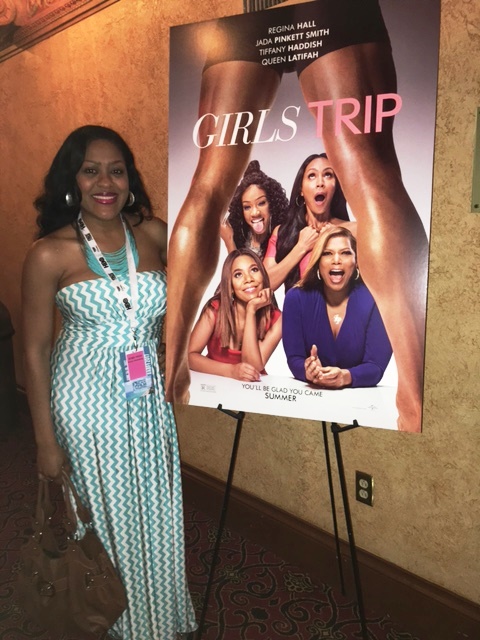
Opening night movie screening of "Girls Trip"
Although it didn't take me long to be "happily overwhelmed" with things to both do and see (for example, even with a well outlined program booklet, I actually showed up one day early to an independent film screening I wanted to see. Sigh.), the connections made were equally as fulfilling. I chatted on opening night with a film veteran whose stories of working closely with the legendary Redd Foxx could have made for a movie itself; had breakfast with a writer who was working on a pilot for an inspirational TV talk show; and had lunch with an entertainment attorney, who shared her journey of leaving behind corporate America to start her own legal firm, which assists minorities with managing their projects.

I walked to a morning class with an events planner pursuing TV script writing; waited in a screening line with an independent film company owner; and chatted numerous times with a young aspiring actor from Queens, New York, who boldly proclaimed he would return to the festival next year, not as an attendee, but as a performer instead. I say, name it and claim it!

The historic Colony Theatre
And don't get me started on the Howard University connections that were made. Let's just say us Bison were definitely here, there, and everywhere, which is not surprising, considering Mr. Friday is, himself, a Howard alum. I can't count the times I either proclaimed or responded to the classic "HU...You know" call, which even actor Lance Gross replied to, as we hurriedly passed each other in the lobby. But most appreciated was the TV executive who took a few moments out of her busy morning to briefly chat with me and, astoundingly, follow-up with our conversation by e-mail only minutes later: an interaction I found to be both surprising and inspiring, at a time when sparing a minute can be impossible for us everyday folk, not to mention the "movers and shakers." So, to say it was a week of "black people magic" would be nothing short of an understatement.

With Erica Ash (Survivor's Remorse) and Jay Ellis (Insecure)
For those of us who consider ourselves "creative minds," the struggle to make connections and take art to the next level can, as is said, "be real." Not to mention it can also be daunting, frustrating, and more than a little disappointing at times. But when you're surrounded by others who share your same dreams (and fears), what you find feels like more than just a connection; it feels like family. They understand the ups and downs; the hustle and the bustle. And from the hugs, high fives, and fist bumps that strangers-turned-friends gave each other in passing within only a few days of meeting, it was all the proof needed that the dream Jeff Friday created 21 years ago is still being fulfilled today.

With actor Boris Kodjoe
The ABFF serves as a reminder that we all have the power to make our dreams come true and as was once said, that when "Hollywouldn't" we have people to support us who will. This may have been my first time at the festival, but it certainly won't be my last. And one year, when I do return, I hope-- as that young Queens native said--it won't be as an audience member but as a featured artist instead. From my lips to God's ears.

Check out these notable premieres coming soon:

Tales created by Irv Gotti - BET - June 27th

Insecure (season 2 premiere) starring Issa Rae and Jay Ellis - HBO - July 23rd

When Love Kills: The Falicia Blakely Story starring Lance Gross and Lil' Mama - TV One - September 4th

Downsized starring Boris Kodjoe and Nicole Ari Parker - TV One - Fall 2017


Friday, June 9, 2017

A Black Music Month Head Nod to Hip Hop

Music. If there has been one constant in my life, my love for it has definitely been it. From a singing mother, to siblings who played instruments ranging from the flute to guitar (and yours truly playing piano), to the numerous concert ticket stubs I've collected since age 9, every good, bad, and sad moment has always had a "sound" to support it. Without a doubt, music has always been the heartbeat of my emotions, whether delivered through r&b, gospel, go-go, jazz--or even a country tune here and there. And then there's that thing called hip hop....

The Pharcyde
On a recent morning commute, 93.9 WKYS' DJ Quicksilva posed the age old question--most notably asked in the 2002 urban cult classic "Brown Sugar"--"When did you fall in love with hip hop?" I smiled as caller after caller dialed into the station to enthusiastically give their answer. What was even more notable were the variation of answers that were indicative of just how long hip hop has been in the game: "Krush Groovin' was my jam" said one caller, noting that she was indeed an "old head"; "Run-DMC's 'Sucker MC's still gives him the chills" said another. "Pharcyde's 'Passin' Me By' was my joint" the next caller exclaimed, which indeed gave me all the "feels," as it marked my college years, when hip hop seemed at its most palpable. There were shout outs to "All About the Benjamins" by Puff Daddy & the Family and "Renee" by Lost Boyz. And then there were the younger callers giving a nod to Lil' Bow Wow.

Salt-N-Pepa
The conversation definitely made morning rush hour less annoying, as I was too gone down Memory Lane to care about bumper to bumper traffic. But then I was struck with a nagging realization: I am never able to definitively answer that question for myself. Sure, there are songs that stick out in my head for various reasons, like "Faye" by Stetasonic, whose (then considered) lewd lyrics on the track and its late-night-only radio play that made us curious teenagers gravitate toward it, and Salt-N-Pepa's "My Mic Sounds Nice" because that mashup of hip hop and go-go was--and still is--rare (and you don't even want to get me started on my love for go-go, being a native Washingtonian. In fact, much respect to SNP for keeping that "marriage" going with this classic).

However, about half way down the highway, it struck me why answering that question has always proved difficult for me: Because asking me "when did I fall in love with hip hop" is akin to asking me "when did I fall in love with my family." It's impossible to answer, as family is something that's just a part of us; we come into it and the love for it is just there.

There's no defining moment or anything spectacular someone did that brings you to it. There's no exact moment when you decide to open your heart to it. You just love it and it loves you back. Yes, there may be special moments that make you appreciate its existence, but they are a part of the fabric that makes you, you--and for most of us, so is hip hop. And being a '73 baby born just around the time the genre made its debut, let's just say hip hop and I grew up and evolved together from rambunctious kid, to explorative teen, to conscious adult. 

Whether it was there as you navigated your first dance (shout out to Doug E. Fresh's "The Show" and Michele's 12th birthday basement party) or when you got your first pair of Bamboo earrings (shout out to LL Cool J's "Around the Way Girl") to when you had your first crush (shout out to Heavy D's "Don't You Know") to when you had your first "real" heartbreak (shout out to Common's "Retrospect for Life") to when you realized some ish needed to change (shout out to Public Enemy's "Fight the Power") to so many other landmark moments, hip hop has no doubt always been there--just like family.

Me groovin' to hip hop in Barcelona
So I no longer feel odd not having an answer to that quintessential question, for it doesn't require one. Instead, and in celebration of June being Black Music Month, I rather just say "thank you" to hip hop. Thank you for always being that "ride or die" when I needed you; thank you for always providing that drive in my spirit to take on whatever challenge I faced; and thank you for being that joy that could make me throw my hands in the air, close my eyes, and shout out "Yassssssssssssssssss!" with the drop of one beat. Hip hop, you are appreciated and will forever be kin. 


Photo Credits: N/A

Tuesday, May 23, 2017

A Somber Case for HBCUs

Richard Collins III
My heart has been heavy the past few days, due to the murder of Bowie State University student, Richard Collins III--a promising 23-year-old who was set to receive his diploma today on the very site he was slain: the University of Maryland campus, where Bowie holds its commencement exercises. Collins, described as a young man who made friends easily and often went out of his way to help others, recently completed Bowie's rigorous Reserve Officers' Training Corps regimen and had already been commissioned as a second lieutenant in the U.S. Army. On the early morning hours of Saturday, May 20th, Collins, who was waiting with friends for an Uber after a night of celebrating his impending graduation, was randomly approached and stabbed to death by a 22-year-old white University of Maryland student. Because of the student's involvement in an online Facebook group called "Alt-Reich: Nation," which features bigoted posts, the murder is now being investigated as a hate crime.

It would not be long before several University of Maryland Terrapin students would hijack the school's popular "Fear the Turtle" slogan and turn it into a hashtag to share their own encounters of racism on UMD's campus:

"when a group of my friends were told "our kind" was not wanted at a party my freshman year"

"being the only black man on the floor of my freshman dorm gave a coward the courage to call me the n word through the walls"

"when a UMPD officer whispered in my AfAm student's ear: "I could f*ckin' ruin your life right now if I wanted to."

"when the bus driver told black students the bus was full but let white students get on right after"

"I turned down a full ride to Howard & Hampton to be disrespected and unprotected at UMD. If I knew what I know now.."

What we do know is that racist expressions in this country--this world, in fact--are nothing knew and certainly not unheard of on college campuses, particularly at PWIs--predominately white institutions. In fact, a few friends of mine who attended PWIs would share similar stories with me regularly when we reconnected over Spring break. That was over 20 years ago and, as recent as last year, my nephew shared those same experiences with me that he'd encountered at a well respected  PWI in New York City. However, when those derogatory racial expressions manifest into actions that lead to deaths, the hard, uncomfortable conversations must be had. Unfortunately, according to several UMD students, its administrators don't seem ready--or willing--to do that. Whether that's true or will change soon, remains to be seen.

However, this senseless incident motivated me to have my own "water cooler" conversation at work with a fellow co-worker, who happened to be both African-American and a UMD graduate. Sparing the details of the conversation, I'll just say in the end their Terrapin pride would not fully allow them to criticize the lack of action from this institution on whose ground this hideous crime occurred. I didn't relent in my argument, but I also understood their struggle to fully support mine. As a proud Howard University graduate, anyone who knows me will tell you, I can talk about my University all day but YOU can not. It's just like family. So his inability to put aside his alumni pride in order to fully engage in the conversation was disappointing but not surprising. However, one poignant moment that came out of our exchange was his sharing his own past experiences with racism on UMD's campus and of being called the N-word on occasion during his time there. He then said to me, "Well, you know how it is..." before correcting himself and re-stating, "...actually you don't, because you went to Howard." My response: "Exactly."

Graduates at Howard University Commencement
Now, let me be forthright: I was accepted to the University of Maryland as well, and Bowie State, and Tuskegee, and a few other historically black colleges (HBCUs) and PWIs. However, I chose Howard because I had one goal in mind: to be a great journalist, and I heard Howard, less than 10 miles from my childhood home, had an outstanding School of Communications, which I quickly learned was true. At the time, I wasn't motivated to attend Howard for the opportunity to engage more with people who looked like me. After all, I grew up in Prince George's County, noted as the richest African-American county in the country. I was always majorly surrounded by people who looked like me, whether in church, in my community, and from elementary school to high school. So Howard was not a departure from the norm, it was just more of the wonderful same.

However, I soon realized that my upbringing was different than most students I encountered on campus, who rejoiced in the opportunity to openly celebrate themselves, their culture, and their heritage without judgment, fear, or backlash. Although I was firmly steeped in my "blackness," I did come to appreciate the freedom inside the classroom to speak openly about my people's history (and not just in February, as is the norm in standard school curriculum), and dive deeper into our many contributions.

Students at Cheyney University--the U.S.'s first HBCU
The pain and hurt from racism--both directly and institutionally--that most of had mastered pushing down and setting aside on a daily basis in order to assimilate into the larger society, could now be released and dissected openly among peers, and guided by intellectuals, who were readying all of us for the realities of an unfair and, often, unkind world that does see "color." Ironically, one of the most commonly spewed criticisms I've heard from people about those who choose to attend HBCUs is that students are not prepared for the real world. On the contrary, I'd argue that HBCU students are equally as prepared for the real world, if not more, as we enter it armed with a better sense of knowing who we are which, when coupled with our educational prowess, allows us to stand firm in any situation we are placed. We don't shrink when challenged; we don't scurry when confronted; and we don't settle for less than what we deserve. If that isn't preparation for navigating the real world, then I have no idea what is.

Collins graduation robe displayed at BSU Commencement.
I believe Richard Collins III was already a dynamic young man, due in part to his loving mother and father, who raised him to be all that he became in his brief 23 years on earth. But I also believe he embodied even more "fearlessness" and tenacity thanks in part to the love and nurturing he received from his family at Bowie State University, whose motto "Prepare for Life" is instilled in its students every day. At a time when United States Secretary of Education Betsy DeVos can be ignorant enough to call HBCUs forged at the height of racial segregation “pioneers” of  “school choice” (when in fact HBCUs were then the only choice for African-Americans, less one be caught at a PWI and risk becoming "strange fruit" hanging from campus trees), and as our country's Administration flirts with cutting funding from HBCUs because they're no longer seen as "needed," in the memory of Richard Collins' and the hateful racism that caused his death, I beg to differ and hope it serves as a reminder not only of the necessity of these schools but also of the work that still needs to be done to heal an insufferably, sick world.

This is not to say that HBCUs don't have their share of headaches and heartaches; God knows they do. But at a time in a young person's life when balancing Calculus classes, tuition fees, and marching band rehearsals is stressful enough, at the very least, a student should be able to cross a college campus in peace without carrying the weight of a racial slur shouted at them in addition to their backpack full of books. Life will provide enough opportunities for race to rear its ugly head; an institution of "high learning" should not be one of them.

RIP Brave Soldier. Your HBCU family salutes you.

Photo Credits: N/A


Tuesday, May 2, 2017

The Audacity to Be Both Black and Great


As I sat in typical DC rush hour traffic this morning, my text message indicator went off. It was a message from a friend. No explanation; no pre-commentary. Just a Twitter post link. As I often do, I searched for a key word in the link before opening and saw the word "Diddy." I immediately said out loud, "Oh this is gonna be good" in a I-know-this-is-going-to-contain-some-foolery-as-only-Diddy-can-bring kind of good. And yet he did not disappoint, for there he was styled in a black suit with a full-length embellished cape flanked by long-time "boo thang" Cassie in her own head-turning, full-length black gown.

They could have sashayed down the Metropolitan Museum of Art's Gala's red carpet with an equal amount of showmanship as any of the other styled-too-death couples, except for one thing: Diddy took his entrance up a notch (and perhaps Cassie's down two) when he, as he said, "got tired," and decided to rest on the MET stairs. Now, I'm sure Diddy wasn't that tired. But you don't get to be a multi-millionaire celebrity without a few calculated, attention-grabbing moves along the way. And so the photo went viral, Twitter went crazy, and I lost at least two hours of my morning once I got to work laughing at the numerous memes that were created from his now iconic move. Initially, I admit, my first reaction was of annoyance, as Diddy is never short of being, as folks say, "extra." After all, this was THE premiere fashion event of the year. Who would dare show it any contempt?

As an alum of Howard University along with Diddy, I recall the great divide between alumni over his being asked to deliver the Commencement address back in 2014. Many who knew "Sean" personally during his school days thought his being asked was a fitting invitation marking all of their "come up" from school boy to certified "Bad Boy"; however, many of us who hold Commencement at "the Mecca" in high regard were not so excited, as we held our collective breath on whether or not he would leave his "extra" at the gate of the Yard. Let's just say that in the end, both sides of the debate got a little of what was expected: a crowning moment of achievement with a dash of "turn up." But again, this is--and probably always will be--Diddy. And upon further reflection, I'm okay with that.

You see, at the same time Diddy was setting Twitter ablaze, another topic was also trending: that of Baltimore Orioles All-Star center fielder Adam Jones, who was berated by racist taunts at Fenway Park Monday night, while a bag of peanuts was thrown at him. Jones called it one of the worst cases of fan abuse he has heard in his career and, yet, he was doing nothing more than his job. And then my attention was pulled to a Washington Post article where African-American quadruplets, Nick, Nigel, Zach, and Aaron Wade, from Liberty Township, Ohio, announced their plans to attend Yale. It was an announcement many were awaiting, as the four had each gotten accepted into every Ivy League school they applied to, including Harvard, Duke, Georgetown, Stanford, Cornell, Johns Hopkins, and Vanderbilt. 

Three examples of excellence in entertainment, sports, and academics on display in one day. And although most comments on social media outlets were positive (and hilarious), as usual, there were several where race was again front and center:

On Diddy: "Why are we like this??"

On Jones: "What I learned on twitter today: Negro's get offended if you throw peanuts at them!"

On the Wade Quad: "Notice how none of them are named Tyreek, Jaquiz, or LaTron."

And then I was reminded of something my mother always said: "Damned if you do; damned if you don't." Even if all you're doing is having the audacity to be your best self, there's always someone lurking in the shadows with criticism--even if that someone is our subconscious self. 

You see, what most in our community may be too shy to admit is that America's complex history has always created an internal conflict within us as well; a juxtaposition of sorts between us "doing too much" and being "acceptable to the masses." And because we've been both equally praised and ridiculed for our (often imitated) unique flair and execution of expression, we unconsciously find ourselves struggling between being who we are and being who "society" says we should be. For every time someone acts "too extra," we mentally cringe out of fear that their liberation somehow shackles our own progress. Don't be too loud. Don't be too expressive. Don't be too angry. Don't be too outspoken. Don't be too funny. Don't be too extra...lest we all be judged as being "too Black." 

Now, I'm not saying "carte blanche passes" should be given for any outlandish or offensive behavior, regardless of race. However, if wearing outfits of meat to awards shows and riding half clothed on wrecking balls can somehow be celebrated as "trendy," then we have the audacity to be both unique, Black, and "extra" without apology, fear, or explanation. There will always be someone with something to say, but as the most expressive artist of our current day, Kanye West, said, "I'd be worried if they said nothing." So, here's to all of us with the courage to stand in our greatness, however we choose to express it, whether we're slaying--or laying on--the red carpet, excelling academically, or hitting a home run. Zero cares given. No criticism needed. Thank you for noticing.

Photo credits: N/A


Sunday, April 23, 2017

Review: Immortal Adaptation 'Lacking' Depth but Worthy of Recognition

On Saturday, HBO debuted the story of one of American history's greatest medical miracles made possible by one of African-American history's greatest unsung heroes. Although the story was quietly known in medical circles and also addressed in a four-page June 1976 Ebony magazine article titled "The Miracle of 'HELA,'" most Americans had no idea that the research which led to advancements for cures in treating polio, tuberculosis, cancer, Parkinson's disease, HIV, and numerous other diseases, were made possible by the most important cell line in medical history: the immortal cells of Henrietta Lacks; cells that continue to multiple until today.

Lacks, a then 31-year old African-American mother of five from Baltimore, Maryland, found herself at the center of medical history on her death bed at Johns Hopkins Hospital, when upon being treated unsuccessfully for cervical cancer, her cells were taken, tested, and multiplied for scientific advancement all without her knowledge, the knowledge of her family and, most shockingly, without any compensation for her remaining survivors; compensation that still has not been received.

Just as swiftly as Lacks was making history, she was also being erased from it by doctors who in 1951 changed her name to Helen Lane to hide her identity and then used the first two initials of that first and last name to identify her cells. And that's where Lacks' story ended for many, until a young freelance, science writer--Rebecca Skloot--heard of the immortal HeLa cell line in a biology class and was ignited to learn all she could about Lacks, in an attempt to bring her story out of the darkness of lab rooms and into the spotlight for all the world to know. Thus, the biography "The Immortal Life of Henrietta Lacks" hit bookshelves with rave reviews in 2010, stayed on the New York Times best sellers list for six years, and was re-birthed on the television screen this past Saturday.

Produced and starring Oprah Winfrey as Lacks' daughter, Deborah, and starring Rose Byrne as Skloot, award-winning director George C. Wolfe's attempt to bring the complexity of Lacks' life, death, family, and unsung heroism from the page to the screen would prove challenging. Personally, having read Skloot's biography when it debuted, each night I committed to the novel was a roller coaster ride filled with frustration, disbelief, and personal pain, having lost my own mother to cancer a few years prior. Though I was 30 when I lost my mother, the Lacks children were far younger at her death, and the inability to manage life without their matriarch led to a family legacy wrought with crime, depression, and mental illness, exacerbated by years of confusion and fatigue in their struggle to learn who their mother was (in particular, for the children who were too young to fully remember her) and adequately tell her story. As Skloot carried readers on a long, arduous journey to deliver Lacks' story, told primarily through Deborah, unpacking such an enormous yet mysterious life was surely daunting for Skloot but was, nonetheless, done masterfully in 381 pages. Like a hearty meal, Skloot's masterpiece required slow, careful digestion.

This is why Wolfe's adaption at a mere :95 minutes could not begin to do Lacks or her family's story the justice it continues to deserve. As are many of us, Lacks' children and relatives are both colorful and complex, in having to live in the shadow of their mother's enormous legacy yet without receiving any true acknowledgment of her life. Though Lacks physically left them over half a century ago, the concept of her "living" on for eternity is as hard for them to grasp as it literally sounds. However, on screen, the portrayal of these offspring feel rushed and one-dimensional, without much feeling or depth to unveil the pain they bore and continue to bear.

Further, Oprah in the leading role as Lacks' troubled, youngest daughter struggling with bipolar disorder, while uncovering the mystery of her mother's immortality, is both a blessing and a curse: a blessing as her name alone most likely drew many to the HBO adaptation where many possibly first learned of Lacks, but a curse in that, with a persona as large as Oprah's, it distracts from the real character: Lacks' story itself. There's not much Oprah has not or can not do well, but perhaps a lesser or unknown actress would have allowed all the space that was needed for Lacks' story to soar on screen, while allowing a newcomer's career to set sail as well. Furthermore, Wolfe's adaption largely tells Deborah's story and, while rightfully needing to be told as well, it somehow continues to leave Lacks' story as a secondary character yet again--much like the secondary character she's always played to her own immortality.

HeLa Cells
Regardless, the more Lacks' story is told in any capacity and on any platform is always a win. Knowing that many of us owe her contribution to science to our own healing or the healing of any family member or friend who's fought--and won--a life-threatening illness, is a gift that can't be measured. Henrietta may have "lacked" notoriety and fame while alive, but what we've gained from her death is too monumental to truly be contained by any medium, be it on a page or on a screen. Yet, for all she's quietly and unknowingly done to change history, she always deserves to be celebrated--immortally.

Photo Credits: N/A